
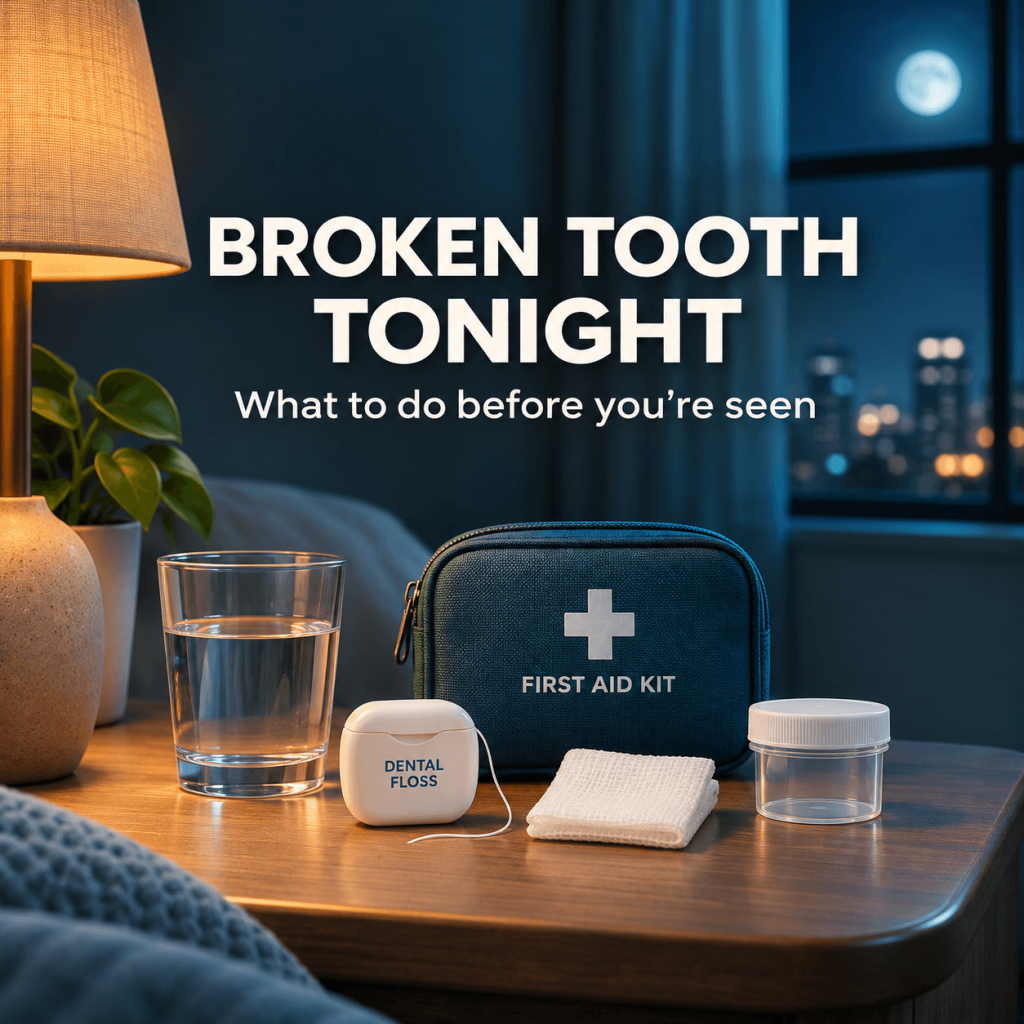
A popcorn kernel. A fork. A random slip on the stairs. Or you’re just brushing and you feel it, that sharp little edge that definitely was not there this morning.
If you broke a tooth tonight, your goal is pretty simple: protect the tooth, protect the nerve, keep pain down, and avoid turning a small fracture into a full-blown emergency before a dentist can actually see you.
This is the at-home, right-now plan.

First, take 30 seconds to figure out what kind of “broken” this is
You don’t need to diagnose yourself perfectly. Just try to notice a few things because it changes what you do next.
Check these:
- Is there bleeding that won’t stop?
- Is a big chunk missing, or just a small chip?
- Do you see a pink or red dot in the center of the tooth? (That can mean the nerve is exposed.)
- Is the tooth loose or pushed out of position?
- Is your face swelling quickly, or is swallowing/breathing affected?
If you have trouble breathing, severe facial swelling, or uncontrolled bleeding, skip the rest and go to urgent care or the ER first. Dental offices handle emergencies, yes, but airway problems and fast spreading swelling come first.
Step 1: Rinse gently, don’t “scrub” the area
Use warm salt water if you can.
- Mix 1/2 teaspoon salt in a cup of warm water
- Swish gently for 20 to 30 seconds
- Spit. Repeat once or twice.
This helps clear saliva, blood, and tiny debris. It also calms irritated gum tissue.
Avoid mouthwash with alcohol tonight if the area is raw. It can sting and dry things out.
Step 2: If there’s bleeding, apply pressure the boring way
Grab clean gauze. If you don’t have gauze, a clean cloth or even a thick paper towel works in a pinch.
- Place it over the area
- Bite down with steady pressure for 10 minutes
- Don’t keep checking every 20 seconds. That restarts bleeding.
If you suspect the tooth is broken because of a fall or hit, and you also have lip or cheek cuts, pressure still works. Just be gentle.
Step 3: Find any broken pieces (yes, even tiny ones)
If you can safely find the tooth fragment, do it. Dentists can’t always reattach it, but sometimes it helps with repair options or shade matching later.
- Pick it up carefully
- Rinse it with water (do not scrub)
- Put it in a small container with milk or saline, or even your own saliva if nothing else
Don’t store it dry in tissue all night. That tends to make it brittle.
Step 4: Protect sharp edges so you don’t slice your tongue in your sleep
A broken tooth can feel like a tiny knife. And the tongue always finds it. Always.
If there’s a sharp edge:
- Use orthodontic wax if you have it (drugstores often carry it)
- If you don’t, you can use a piece of sugar-free chewing gum (temporary, not ideal, but better than nothing)
- Some pharmacies sell temporary dental filling material. That can also act like a “cap” for the night.
Try not to pack anything deep into the broken area if it hurts or if you suspect the nerve is exposed. The goal is just to cover sharpness, not rebuild the tooth on your kitchen counter.
Step 5: Pain control, without making things worse
If you can take them safely, ibuprofen often works well for dental pain because inflammation is a big part of the discomfort. Acetaminophen is another option.
A few important notes:
- Follow the label. Don’t “double up” randomly because you’re stressed and it’s midnight.
- Don’t place aspirin directly on the gum or tooth. It can burn tissue.
- Avoid alcohol as a “painkiller.” It tends to backfire and increases bleeding risk.
Cold compress helps a lot, especially if trauma caused the break:
- Ice pack or cold cloth on the cheek
- 10 minutes on, 10 minutes off
If the pain is sharp and zinging with cold air, try breathing through your nose and keep the area covered with wax. That sensitivity can be brutal.
Step 6: What to eat (and what to absolutely not eat)
Tonight, treat that tooth like it’s made of glass.
Eat:
- Yogurt, smoothies (not icy cold), soup (warm, not hot)
- Eggs, oatmeal, soft rice
- Pasta, mashed potatoes
Avoid:
- Anything crunchy: chips, nuts, hard crust pizza
- Anything sticky: caramel, gummies
- Super hot drinks, especially if the tooth is sensitive
- Chewing on the broken side, even if it “doesn’t hurt that much”
Also, don’t test it. People always do the little bite test. “Let me see if it still hurts.” It usually still hurts.
Step 7: If the tooth is loose or pushed, don’t force it back
If the tooth is loose, shifted, or you think it’s cracked below the gumline, don’t wiggle it. Don’t bite hard on it to “set it.”
Keep it protected and get seen as soon as possible. Movement can worsen the injury and complicate treatment.
Step 8: Watch for the signs that mean you should be seen urgently
A broken tooth is not always an “I can wait a week” situation.
Try to arrange urgent dental care if you have:
- Pain that’s getting worse hour by hour
- A visible hole with deep sensitivity (possible nerve involvement)
- Swelling of the gum, cheek, or jaw
- Fever, bad taste, or pus (possible infection)
- A broken tooth after trauma (especially with jaw pain or headaches)
- A broken tooth in a child (timing matters a lot)
Even if it’s “just a chip,” it can still be rough on your tongue and can crack further. Small breaks have a way of turning into big breaks at the worst moment.
What the dentist might do (so you’re not guessing all night)
People like to know what’s coming. Fair.
Depending on the break, treatment might look like:
- Smoothing and bonding (for small chips)
- A filling (if a chunk is missing but the tooth is stable)
- A crown (common if the tooth is weakened or fractured)
- Root canal treatment + crown (if the nerve is irritated or exposed)
- Extraction (if the tooth is split badly or can’t be restored)
And yes, sometimes the pain comes from a crack that isn’t obvious. Those can be tricky, but they’re also exactly why you want an exam and an X-ray instead of just “waiting it out.”
If you’re in Markham and need to be seen
If you broke a tooth tonight and you’re trying to figure out what to do next, the simplest move is to contact a clinic that handles emergency visits and can actually talk you through the next step.
Bright View Dental Care in Markham offers emergency dentistry, along with restorative options like crowns, root canal treatment, and extractions if needed. You can find location and contact details here:
https://brightviewdentalcare.ca/
(And if you’re holding a tooth fragment in a little cup of milk right now, bring it with you. Seriously.)
Quick “don’t do this” list (because these are common)
- Don’t chew on the broken tooth to “see if it’s okay”
- Don’t use superglue. Not even a tiny bit.
- Don’t shove random household items into the hole
- Don’t ignore swelling that’s getting bigger
- Don’t keep touching it with your tongue. I know. But try.
The goal for tonight
You’re not trying to fix the tooth tonight. You’re trying to stabilize the situation so it doesn’t get worse while you wait to be seen.
Rinse. Control bleeding. Protect sharp edges. Manage pain safely. Eat soft. And line up a dental visit as soon as you can.
In situations where there’s significant injury, tactical combat casualty care principles can be applied, such as controlling bleeding and managing pain safely.
Broken teeth don’t usually improve with sleep, unfortunately. But you can absolutely keep it from becoming a bigger mess by morning.
FAQs (Frequently Asked Questions)
What should I do immediately after breaking a tooth at home?
First, take a moment to assess the break by checking for bleeding, missing chunks, nerve exposure (pink or red dot), looseness, or swelling. Then gently rinse your mouth with warm salt water to clear debris and calm the gums. Avoid scrubbing the area or using alcohol-based mouthwash tonight.
How can I stop bleeding from a broken tooth at home?
Apply steady pressure using clean gauze, a cloth, or a thick paper towel over the bleeding area. Bite down firmly for 10 minutes without checking frequently to allow clotting. If you have cuts on your lips or cheeks from a fall, apply gentle pressure there as well.
Is it important to save broken pieces of my tooth? How should I store them?
Yes, saving any broken fragments—even tiny ones—can help your dentist with repair options or color matching later. Rinse the pieces gently with water (do not scrub) and store them in milk, saline solution, or your saliva to keep them moist overnight. Avoid storing dry in tissue as it can make fragments brittle.
How can I protect my mouth from sharp edges of a broken tooth while sleeping?
Cover sharp edges to prevent cutting your tongue by applying orthodontic wax if available. If you don’t have wax, sugar-free chewing gum can be used temporarily. Some pharmacies sell temporary dental filling material that acts like a cap for the night. Do not pack material deep into the exposed area if it hurts or if the nerve is exposed.
What pain relief methods are safe and effective for broken tooth discomfort at home?
Ibuprofen is often effective for dental pain due to its anti-inflammatory properties; acetaminophen is another option. Always follow dosage instructions and avoid doubling doses out of stress. Do not place aspirin directly on gums or teeth as it can burn tissue. Use cold compresses on the cheek in 10-minute intervals to reduce pain and swelling. Avoid alcohol as it may increase bleeding risk.
What foods should I eat or avoid after breaking a tooth?
Eat soft foods like yogurt, smoothies (not icy cold), warm soup, eggs, oatmeal, soft rice, pasta, and mashed potatoes. Avoid crunchy foods (chips, nuts), sticky treats (caramel, gummies), super hot drinks especially if sensitive, and chewing on the broken side—even if it doesn’t hurt much—to prevent further damage.
